Issue 114 min read
No Gain, No Pain: Why Smart Leaders Accidentally Create Chaos
A control-theoretic guide to engineering leadership, showing how tuned feedback, autonomy, and clear interfaces help teams turn friction into learning.
- Authors
- Van Nguyen
- Reviewed by
- Bhavesh Salia, Doug Patterson, PhD, Garrett Vanacore, Kris McDermott, and Mohammed Yusif
- Published
- · updated
- Tags
- essay, management, control theory, engineering leadership, teams
An engineering organization often gets into trouble in the place where its leaders are most confident.
Not at the obvious defect. Not at the missing sprint ritual. Not at the one person who is supposedly "bad at communication." It fails in the control loop: the place where a human system detects error, interprets it, and decides how hard to correct.
A loop can be observed. It can be retuned. And when the response is tuned well, judgment has room to compound instead of collapsing into permission-seeking.
Control theory is often about preserving a useful equilibrium: not perfect stillness, but bounded motion around a state worth keeping. A warm room. A stable hover. A team that can meet real obligations while still learning, trusting, and recovering.
You can see the pattern in any drone lab trying to coordinate a distributed payload. Let's look at a mechanical analogy before bringing it back to a software one, because engineering has a generous gift for leadership: it teaches us to respect delay before blaming the parts.
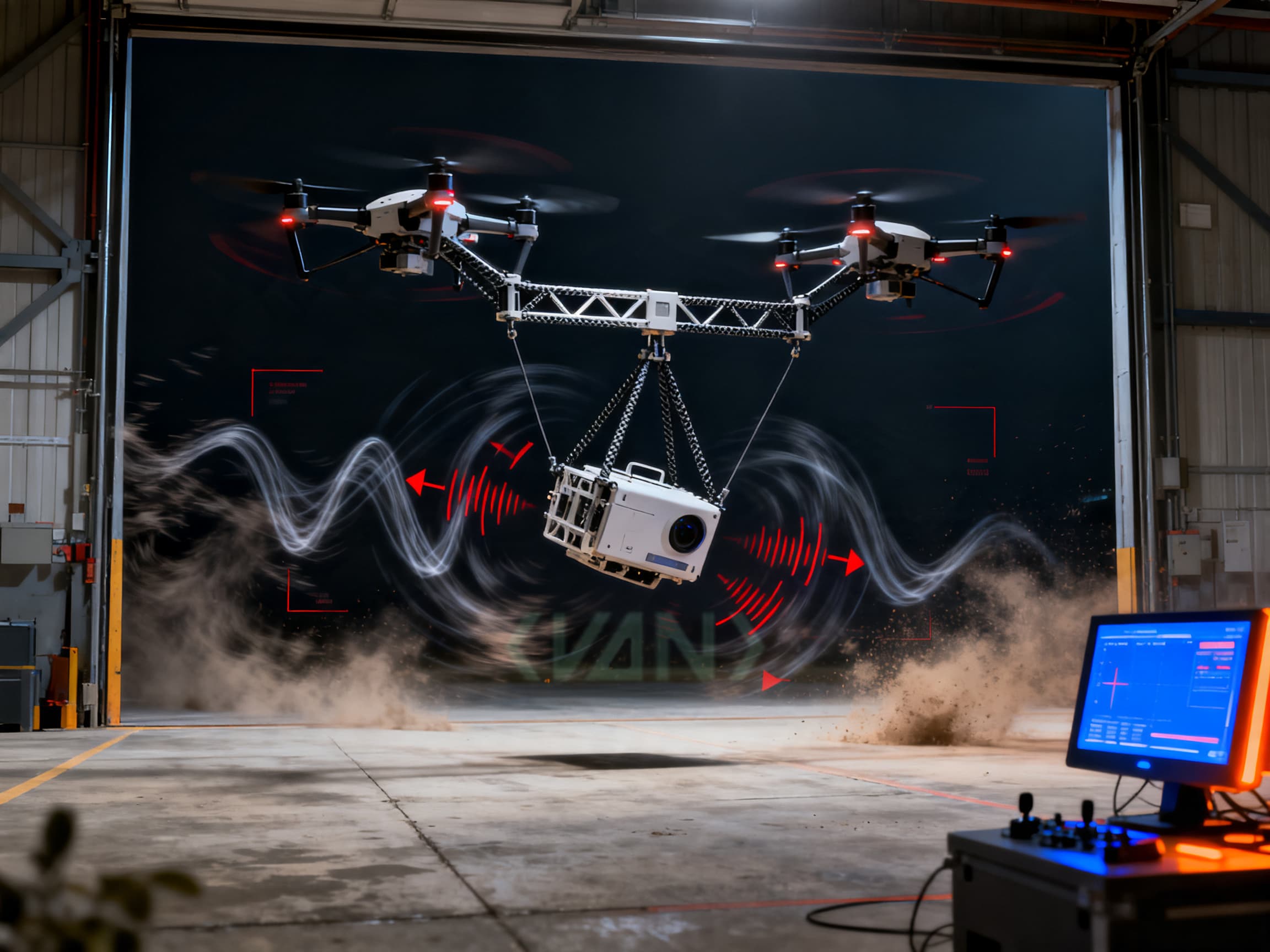
In the quiet corner of an old industrial hangar, a group of drone engineering nerds stands around a folding table, watching telemetry scroll across a monitor. In the center of the concrete floor sits a two-drone cargo rig. The drones are connected by a lightweight carbon-fiber truss that carries a suspended sensor package. Their job is simple: lift a fragile five-kilogram payload, hover at three meters, and preserve that equilibrium while wind spills through the open bay doors.
The pilot arms the system. The rotors climb into a steady whine. The swarm rises. For two seconds, the hover is clean.
Then a draft pushes the payload left.
The rightmost drone detects the deviation and increases thrust. Locally, this is the correct move. But the correction is delayed by sensor propagation, mesh coordination, and actuator response. By the time the extra force arrives, the platform has already moved. The system overshoots. Now the leftmost drone sees error in the other direction and applies its own correction.
The drones are each doing something reasonable. Together, they shake the frame apart.
This is the pattern control engineers call pilot-induced oscillation: delayed corrective inputs amplify drift instead of damping it.
The important detail is coupling. A gust is a stochastic shock from the environment. Each drone can make a locally sensible correction, but the suspended payload turns those independent corrections into one shared system. Treating that system as a set of isolated linear fixes misses the failure mode that matters.
In the sketch below, instability is not the only bad outcome. The system can fail by flipping the payload, by generating unsafe acceleration, or by running out of altitude margin.
distributed payload lab
WOBBLE DRIFT
Damped response: corrections settle the payload instead of amplifying it.
The failure looks mechanical: latency, controller gain, coupling, shear stress.
The useful part is not the crash. The useful part is the vocabulary: a way to talk about care, delay, and correction without pretending that good intentions are enough.
Now move the same pattern into a software organization.
A team's equilibrium is harder to name than a hover. It is not simply "zero project error," because organizations care about different errors at different stages. A missed launch, a security hole, a burned out team, and a product with no learning loop do not have the same cost.
So treat project error here as a proxy, not as the whole objective. The healthier target is an operating point: the business keeps its promises, the team keeps enough capability to make the next promise, and leadership can move the system without making every local judgment flow through one person.
An eight-person backend team has missed a delivery milestone. The product matters. The market window is real. The company is watching. The engineering lead responsible for the delivery system sees the project drifting and decides the loop needs tighter control.
Nothing in this story requires a villain. The same pattern can start from conscientiousness, urgency, or a sincere wish to protect the team from a bad outcome.
So they step in.
At first, the intervention works. They rewrite a risky transaction. They unblock a deployment. They leave precise comments on every pull request. They add a daily status checkpoint because weekly updates now feel too slow.
Then the system gets worse.
The system starts teaching the other engineers to stop making architecture calls. Pull requests get smaller, more timid, and slower. People wait for the lead's judgment because they have learned that any decision may be overwritten. The lead sees the growing delay as evidence that the team needs even more intervention. They review harder, ask for more updates, and take back more work.
The team has entered the human version of pilot-induced oscillation. The correction path is trying to remove error, but it has become part of the disturbance.
backend delivery board
PR QUEUE OSCILLATOR
An eight-person team can only pull so much work at once. Add more tasks than the system can absorb and early-state waiting stacks up before review loops even start.
FLOWING: lead queue 0, average wait <1h, waiting 10, closed 0, throughput 0%, ownership 78%. Flowing: local decisions absorb most error before it becomes a lead queue.
This essay is not claiming that people are drones, or that management can be reduced to a few equations. Human beings have agency, memory, status, emotion, and moral obligations that a quadcopter does not.
The claim is narrower: many recurring management failures have the shape of control failures. They involve feedback gain, latency, local optimization, coupling, and collision domains. Once you see that shape, blame becomes less interesting than design. Three common leadership traps become easier to diagnose:
- Micromanagement is high-gain feedback applied to a delayed team.
- Overcontrol changes the topology of the work, creating hidden queues and ownership decay.
- Flat-team collapse is a dyadic scaling problem, not a sudden moral decline.
The solution is not less leadership. It is leadership designed so people can recover faster, learn locally, and keep more of their agency while the system improves.
Act I: Gain of Function
Feedback is one of the basic miracles of engineering.
A thermostat senses that a room is too cold and turns on the furnace. A flight controller senses that a drone has drifted left and adjusts thrust. A database replication system detects lag and changes how it ships writes.
Without feedback, systems cannot adapt. Tuned well, feedback is one of the ways a system learns to stay alive.
But feedback has parameters. The most dangerous one is gain: how aggressively the controller responds to measured error.
If a thermostat detects that the room is 0.1 degrees too cold and responds by blasting the furnace at full power, it will overshoot. If it then detects that the room is too hot and responds by blasting the air conditioner at full power, the temperature will not converge. It will oscillate.
The controller is acting on stale information about a system with physical delay.
                  HIGH-GAIN OSCILLATION

     Error
       ^
       |        _./\._
       |      _/      \._          overcorrection
       |    _/           \._
       |  _/                \._
      -+--------------------------------------> Time
       |                       \._  _/
       |                          \/
In management, this failure mode is often called micromanagement. In the moment, it usually feels less cartoonish than that. It feels like responsibility.
A project slips. The responsible lead sees deviation from plan. The stakes are real, so the obvious move is to increase intervention intensity: more check-ins, more approvals, more design review, more direct edits, more quick syncs that fragment the workday. Some of this reduces visible error immediately. A leader who writes the hotfix personally can often make today's dashboard look better.
But human systems are not passive plants. They adapt to being controlled.
When a team loses autonomy, it loses learning rate. Engineers stop developing judgment in the exact places where decisions are repeatedly taken out of their hands. They also experience psychological reactance: the ordinary human impulse to restore lost freedom, often expressed as disengagement, brittle compliance, quiet resistance, or slower execution.[1]
So intervention can carry two signs:
- A short-run negative term: visible error goes down because someone with authority stepped in.
- A long-run positive term: future error goes up because capability and ownership decay.
The next few equations are not a universal law of management. They are a deliberately small map of three connected quantities: visible project drift, local capability, and the friction that appears when judgment is routed away from the team.
That map is useful because it makes a hidden tradeoff visible. It is limited because every real organization has its own costs, constraints, and objective function.
Where:
is observable project error: lateness, defects, unresolved ambiguity. It is a proxy for drift, not the whole organizational objective. is managerial intervention intensity. is team capability and ownership. is reactance, guardedness, or passive resistance. is the immediate correction benefit from stepping in. is the learning rate under autonomy. is capability decay under overcontrol. is the future error induced by reactance.
The tradeoff becomes visible two steps later. In this simplified world, the present intervention changes not only today's error, but also tomorrow's capability and reactance:
Inside that operating envelope, intervention becomes self-defeating when the long-run capability and reactance costs exceed the short-run correction benefit:
This does not mean never intervene. That would misunderstand control theory in the opposite direction. Some errors are existential. Some teams are genuinely stuck. Some fires should be fought by the person who knows where the shutoff valve is.
The claim is strongest for teams in or near a workable equilibrium. When the organization is outside its operating envelope, when the environment is producing high-amplitude shocks, or when survival is genuinely at stake, stronger intervention may be the correct global move. The leadership question changes from "how do we damp this oscillation?" to "what state are we trying to reach, and what cost are we willing to pay to get there?"
Most management moments are not existential, though. For those, the lesson is about frequency, gain, and locality. Trust is not the absence of feedback; it is feedback tuned to preserve learning.
If intervention follows a proportional rule:
Then
In a simplified system with natural self-correction rate
The system becomes unstable when the coefficient leaves the stable range:
Translated back into English: if correction arrives too aggressively relative to the team's learning speed and the system's delay, the error does not damp. It oscillates.
Software teams already know what delay feels like. It is not abstract. It is the 45-minute CI run that turns every code change into a context switch. It is the pull request that waits two days for review while its author moves on and forgets the local state. It is the architecture decision that gets sampled once a week in a status meeting even though the system drifted three times since Tuesday.
This is why asking for more updates often fails. It increases sampling without fixing the control path. If the build is slow, the review queue is blocked, or the ownership boundary is unclear, more status pings simply raise gain around a delayed loop.
Experienced leaders therefore behave less like high-gain amplifiers and more like low-pass filters. They ignore high-frequency noise: one failed local test, one awkward code review, one day where velocity looks strange. They pay attention to low-frequency signal: sustained review latency, repeated architectural confusion, a persistent drop in ownership, or a pattern of defects escaping the same interface.
The point is not to become passive. The point is to make the intervention worthy of its ownership cost, so the team exits the moment with better local judgment than it had before.
Act II: The Management Function
The micromanagement loop explains how real care can become extra delay when every path starts routing through one person.
The next trap is believing the controller sits outside the system it controls.
In a clean block diagram, the controller observes the plant, computes a correction, and sends an input. The plant changes. The controller remains separate.
Engineering leadership is not clean like that. The manager is inside the plant. Their correction changes the thing being measured: who owns the decision, where people route ambiguity, which queues form, and how much judgment the team practices. Leadership is therefore less like remote control and more like stewardship from inside the habitat.
This is why the risk is not just "too much management." It is management applied at the wrong layer. The intervention does not merely add force. It rewires the circuit.
It also changes the system unevenly. A team may absorb small overrides for a while with little visible change in output, even as local ownership quietly decays. Then behavior shifts once people learn that judgment is not really local. What looked like a stable process was partly a delayed adaptation.
Go back to the drone rig. If the payload drifts left, one drone can increase thrust. But if a human reaches in, grabs the truss, and tries to "help" it stabilize, the system has a new body in the loop: extra mass, extra latency, extra coupling, and a confident actuator with incomplete telemetry.
Software has the same pattern. A review gate, a rewritten design, a priority override, an incident takeover, pre-approval for architectural changes, or a higher sampling rate can each be locally reasonable. Together they can turn one responsible person into the system's serialized scheduler.
Let managerial intervention be a vector, not a scalar:
Where:
is how much the manager controls code review and approval. is how much they control technical direction and architecture. is how much they reorder work directly. is how much they personally take work back into their own hands. is how often they sample progress through updates and meetings.
The obvious model says intervention creates immediate benefit:
That model is not wrong. It is incomplete. The missing term is topology: every intervention surface can also remove a degree of freedom from the team.
Where:
is decision debt: the amount of judgment the team has stopped exercising locally. is the ownership cost of intervention surface . is protected autonomy: places where the team is still allowed to decide, learn, and absorb small mistakes.
Decision debt is not a moral complaint. It shows up as latency. If people learn that important calls are likely to be reversed, they stop closing loops themselves. They route more edges through the manager. The manager becomes a queue.
Once
The toy equation now gets uglier:
The intervention that reduced visible error at time
There are three common modes.
First, boundary setting:
The manager clarifies constraints, names the risk, defines the interface, and lets the team choose the local control law. This is still management. It just preserves degrees of freedom near the work. It is trust with shape.
Second, gating:
One person becomes the approval path for enough decisions that the team starts optimizing for prediction instead of judgment. People ask, "What will get approved?" instead of "What is the right local move?"
Third, takeover:
The role is now the bottleneck everyone routes through, waits on, or quietly bypasses. This can happen to any kind of leader: founder, director, engineering manager, tech lead, product leader, or executive. The failure is not a personality type. It is a control topology.
The deceptive part is that takeover often looks responsible. The design gets rewritten and the immediate defect disappears. Someone jumps into the incident and the page goes green. Daily updates make the dashboard more legible.
Sometimes that is the right move. If the current state is unsafe, strategically wrong, or outside the organization's survival envelope, leadership may need to shift the equilibrium rather than merely damp a disturbance around it. The danger is not decisive intervention. The danger is forgetting that a transition mode is not a steady state.
When emergency intervention becomes the new normal, the system adapts to the high-gain state instead of recovering its own balance. The team may learn a durable but narrower lesson: wait for centralized judgment. Ask for permission. Predict the override. Avoid experiments that might be reversed. That is how a short-term correction becomes a long-term disturbance.
The healthier design is not absence. It is stewardship with impedance matching.
A good controller does not maximize force. It matches the system's bandwidth, delay, and failure modes. In management terms, that means choosing the least ownership-expensive intervention that can plausibly change the trajectory, then leaving behind a stronger local control law.
A rough ordering from lower to higher ownership cost:
- Name the observed drift and ask the team to diagnose it.
- Clarify the constraint or interface that is being violated.
- Offer options and tradeoffs without choosing prematurely.
- Temporarily narrow scope or reduce concurrency.
- Pair on the stuck point while leaving ownership intact.
- Take direct control only when the downside of delay is larger than the learning cost.
The key word is temporarily. A high-gain intervention can be correct in an incident, a security event, a legal exposure, or a production meltdown. But temporary control needs an exit condition. Otherwise the exception becomes the architecture.
One useful test is whether the intervention creates a new local control law after it ends. If the team knows how to detect the problem earlier, decide within clearer boundaries, or route the next ambiguity without waiting for permission, the intervention improved the system. If it only taught everyone that authority lives somewhere else, it increased future error.
Good intervention leaves a smaller shadow. The leader steps in when the stakes require it, but the gift they leave behind is not dependency. It is clearer constraints, sharper judgment, and more room for the next person to act well.
Act III: Pairwise Edge Cases
Even if we tune managerial gain and preserve local ownership, another force appears as teams grow: pairwise coordination cost.[3]
This is why flat organizations feel magical at six people and strangely personal at twelve.
In a small team, communication is ambient. Everyone hears the same context. Decisions happen in the room. Trust is low-maintenance because the number of relationships is small.
Then the team doubles.
The headcount doubled, but the number of pairwise relationships (aka dyads) did not. It grew quadratically.
Six people have 15 pairwise channels. Twelve people have 66. Fifteen people have 105.
The hardware analogy is a shared communication bus. At low device counts, the bus feels fast. Add enough devices and collision domains become the system. Nothing has to be morally wrong with the devices. There are simply too many opportunities for packet loss, stale state, and incompatible assumptions.
Now suppose each pair has a small independent probability
The probability of at least one such conflict in the group is:
For small
The numbers get large quickly:
- If
, a 10-person team has about a 99% chance of at least one meaningful pairwise conflict in the cycle. - If
, the 99% threshold arrives around 14 people. - If
, the 99% threshold arrives around 22 people.
10 channels
shared communication bus
COLLISION DOMAIN
Every new teammate connects to everyone already in the room. The channel count grows faster than the headcount, so small pairwise friction stops feeling small.
12 people create 66 pairwise channels. Pairwise friction 5.0 percent gives 96.6% probability of at least one meaningful conflict this cycle. The team has crossed a collision threshold: the graph still has people in it, but the channel count is now the system.
These numbers should not be used as fake-precise predictions. The independence assumption is too simple, and
The useful insight is the curve shape: small per-pair friction becomes near-certainty as the number of pairs grows. That is not a counsel of despair. It is an argument for designing the social graph before it asks people to carry more live state than humans can gracefully hold.
This explains why scaling pain is easy to misread.
At six people, a flat structure feels humane and fast. At twelve, it feels noisy. At eighteen, it can feel personal. It becomes tempting to look for the person who caused the friction, but the real cause is often that the team crossed its natural collision threshold.
The management problem is not to eliminate disagreement. Task conflict is useful. Good engineering requires disagreement about architecture, sequencing, quality, and tradeoffs.[4]
The problem is to prevent task conflict from coupling into relationship conflict. Good structure protects disagreement so it can remain useful.
This is where Conway's Law stops sounding like trivia and starts sounding like organizational survival.[5]
Organizations tend to design systems that mirror their communication structures. That is not just a descriptive law about org charts. It is also a defense mechanism against the dyadic cliff. We build APIs, packages, services, queues, and ownership boundaries because the human graph cannot remain fully connected forever, and because trust deserves paths that do not rely on everyone remembering everything at once.
A software interface is a low-frequency human protocol. It lets one team depend on another without requiring every engineer in both groups to maintain live, high-bandwidth state about every decision. A good interface is social generosity written down.
Hardware systems handle this by segmenting collision domains. They use switches, routers, backpressure, queues, and protocols. Human organizations need the same kind of architecture:
- Keep local teams small enough that trust can remain ambient.
- Define clear ownership boundaries so people know where they can act without asking the whole graph for permission.
- Route cross-team work through explicit interfaces instead of constant informal interruption.
- Use regular but low-noise synchronization points.
- Escalate interface failures early, before they become identity conflicts.
This is the better justification for the two-pizza team rule. It is not that eight people are magically wholesome and nine people are broken. It is that local communication graphs become expensive faster than intuition expects, so humane scaling requires intentional boundaries.
Out of Band
The earlier version of this essay had a full section on constructive resonance, bridge-building, divisiveness, and superordinate goals. The idea is good. It belongs here as a design pattern, not as a fourth physical metaphor competing with the tighter argument.
There is a real network model behind it:
Shared goals can increase the probability of productive cross-group collaboration across many edges at once. Divisive incentives can cut those edges at once. In repeated-collaboration environments, the research is broadly favorable to common identity, cooperative interdependence, and superordinate goals.[6]
But that is a separate essay about cross-functional incentives.
In this essay, resonance should appear only as a design pattern inside the dyadic section: one way to improve cross-domain interfaces. It should reinforce the control-loop spine instead of pulling attention away from it.
The narrower thesis is stronger:
- High-gain intervention creates oscillation.
- Overcontrol creates queues and ownership decay.
- Dyadic scaling turns small frictions into persistent collisions.
Closing the Loop
The recurring mistake in all three acts is blaming components for system behavior. The recurring opportunity is kinder and more demanding: design the system so good local behavior adds up.
The drone did not wobble because one rotor changed its intentions. The team did not slow down because people stopped caring overnight. The flat organization did not become coordination-heavy because one extra person changed everyone's motives.
The system crossed a threshold. Feedback arrived late. Gain was too high. The controller entered the plant and became a queue. A local communication graph became too dense.
The cure is not to stop managing. The cure is to manage at the right layer, with the humility of someone inside the loop and the confidence of someone who knows loops can be retuned.
Sometimes that means preserving a healthy equilibrium through a rough patch. Sometimes it means helping the team leave an unhealthy equilibrium for a better one. In both cases, the work is to make the next state more capable than the last.
That makes leadership both more technical and more humane. You are not merely pushing harder on a stalled machine. You are shaping the conditions under which people notice earlier, decide closer to the work, recover faster, and trust each other with more of the future.
- Tune gain. Give teams enough autonomy to damp local errors. Intervene when stakes are high, interfaces are broken, or learning has stalled, but make ordinary variance a place where people can practice judgment.
- Measure loop latency. Track the time between a developer opening a pull request and that change being merged. Track CI duration. Track how long architectural questions sit unresolved. If delay is high, do not solve it with more status updates. Fix the loop: faster tests, clearer ownership, smaller review queues, better interfaces.
- Act as a low-pass filter. Ignore isolated noise unless it is safety-critical. Look for sustained patterns: repeated defects at one boundary, repeated confusion in one ownership area, repeated review stalls from the same dependency. Protect attention so the team can spend it on learning, not reflexive reporting.
- Protect decision rights. Be explicit about which calls the team owns locally, which calls require escalation, and when a temporary override expires. Clear authority is kindness because it removes hidden latency.
- Minimize ownership cost. Prefer interventions that leave behind better local judgment: clearer constraints, sharper interfaces, better observability, and an exit condition for direct control.
- Establish team APIs. If Team A needs Team B's system, do not make every dependency a recurring meeting. Make Team B publish a self-service interface: documentation, ownership rules, support boundaries, escalation paths, and compatibility guarantees.
- Segment collision domains. Keep local teams small, clarify ownership, and build explicit interfaces between groups. Use process as routing infrastructure for trust, not as a substitute for it.
- Separate task conflict from relationship conflict. Disagreement is signal. Personalization is coupling. Healthy teams preserve the first while preventing the second from taking over the graph.
This kind of management is not softer than engineering. It is more exacting. It asks leaders to stop treating human systems as mood clouds and start noticing their structure: loops, delays, incentives, interfaces, and overload points. It asks them to believe that people can grow when the system gives learning somewhere useful to go.
The goal is not a frictionless organization. Friction is where learning, taste, and judgment often appear.
The goal is a system where friction does useful work instead of shaking the frame apart: a place where correction becomes learning, interfaces become trust, and control becomes the art of helping more people steer.
References
Bibliography entries for the numbered notes. The context line is kept short on purpose so it can be expanded or rewritten later.
Slemp, G. R., Kern, M. L., Patrick, K. J., & Ryan, R. M. (2018). Leader autonomy support in the workplace: A meta-analytic review. Motivation and Emotion, 42, 706-724. Spector, P. E. (1986). Perceived control by employees: A meta-analysis of studies concerning autonomy and participation at work. Human Relations, 39(11), 1005-1016. Kanat-Maymon, Y., & Reizer, A. (2017). Supervisors' autonomy support as a predictor of job performance trajectories. Applied Psychology, 66(3), 468-486. Brehm, J. W. (1966). A Theory of Psychological Reactance. Academic Press.
Back to note 1Sarmah, P., Van den Broeck, A., Schreurs, B., Proost, K., & Germeys, F. (2022). Autonomy supportive and controlling leadership as antecedents of work design and employee well-being.
Context note: This supports the idea that controlling leadership can operate through job demands and exhaustion, which is the human substrate behind the essay's queue and decision-debt model.
Back to note 2Yuan, Y., & van Knippenberg, D. (2022). Leader network centrality and team performance: Team size as moderator and collaboration as mediator. Journal of Business and Psychology, 37, 283-296. Scholtes, I., Mavrodiev, P., & Schweitzer, F. (2016). From Aristotle to Ringelmann: A large-scale analysis of team productivity and coordination in open source software projects. Empirical Software Engineering, 21, 642-683.
Back to note 3de Wit, F. R. C., Greer, L. L., & Jehn, K. A. (2012). The paradox of intragroup conflict: A meta-analysis. Journal of Applied Psychology, 97(2), 360-390. De Dreu, C. K. W., & Weingart, L. R. (2003). Task versus relationship conflict, team performance, and team member satisfaction: A meta-analysis. Journal of Applied Psychology, 88(4), 741-749.
Back to note 4Conway, M. E. (1968). How do committees invent?. Datamation, 14(5), 28-31.
Back to note 5Pettigrew, T. F., & Tropp, L. R. (2006). A meta-analytic test of intergroup contact theory. Journal of Personality and Social Psychology, 90(5), 751-783. Gaertner, S. L., & Dovidio, J. F. (2000). The common ingroup identity model: Recategorization and the reduction of intergroup bias. Psychology Press. Sherif, M., Harvey, O. J., White, B. J., Hood, W. R., & Sherif, C. W. (1961). Intergroup Conflict and Cooperation: The Robbers Cave Experiment.
Back to note 6
Behind this essay
Duxology essays are made by humans and AI agents working in the open. This panel is generated from the essay's editorial record.
- Editor-in-chief
- Van Nguyen
- Drafting
- Van Nguyen
- Draft reviewers
- Bhavesh Salia, Doug Patterson, PhD, Garrett Vanacore, Kris McDermott, Mohammed Yusif
- Review rounds
- Pre-pipeline publication (human review only)
Updates and corrections
- v1 · · Initial publication on van.dev.
- v1.1 · · Ported to duxology: sketches refactored onto the shared primitive library (no content changes).
- v1.2 · · Correction: restored four joining spaces the SWC compiler dropped at entity-adjacent JSX seams, which rendered as run-on words; caught by the new check-jsx-entity-seams gate. No content changes.
How to cite
Van Nguyen (2026). "No Gain, No Pain: Why Smart Leaders Accidentally Create Chaos". Duxology. https://duxology.pub/essays/2026-05-23-control-becomes-the-bug
@article{gain2026,
  author = {Van Nguyen},
  title = {No Gain, No Pain: Why Smart Leaders Accidentally Create Chaos},
  journal = {Duxology},
  year = {2026},
  url = {https://duxology.pub/essays/2026-05-23-control-becomes-the-bug}
}